
One year after a tragedy that killed 67 people near D.C., the National Transportation Safety Board (NTSB) presented its investigation into the crash.
On January 29, 2025, a U.S. Army Black Hawk helicopter and an American Eagle regional jet operating as American Airlines Flight 5342 collided over the Potomac River near Ronald Reagan Washington National Airport. All 64 passengers and crew on the jet and all three service members aboard the helicopter were killed.
The crash was the deadliest U.S. air disaster in more than two decades and the first major fatal accident involving a CRJ-700 aircraft.
NTSB Investigation Focuses on Systemic Failures
In hearings held in January 2026, the NTSB revealed that its investigation has grown into one of the most comprehensive in the agency’s history, with investigators reviewing more than 19,000 pages of evidence.
The board has shied away from attributing the tragedy to a single human error. Instead, the board has highlighted what it deems a series of systemic failures that resulted in the crash. Major contributing factors include:
- Air Traffic Control Overload: Controllers managing high traffic density including multiple helicopters and fixed-wing aircraft in the same space reported feeling overwhelmed as traffic volume surged in the minutes before the collision.
- Dangerously Narrow Flight Paths: The helicopter route involved in the accident was too close to the jets approach path, leaving only about 75 feet of vertical separation. FAA officials failed to recognize this hazard in route design.
- Refusal to use “ADS-B Out:” All military helicopters use an anti-collision technology known as the Automatic Dependent Surveillance-Broadcast (ADS-B). However, the Black Hawk helicopter flying on Jan. 29 flew without the technology engaged, despite ground lighting, the fact that it was night, and the numerous blind-spots that exist in the aircraft’s design.
- Communication and Visibility Challenges: Investigators found that radio communications were strained under complex conditions and that pilots visual identification of the other aircraft was limited by cockpit conditions and nighttime lighting.
- Ignored Warnings: The NTSB noted that warnings about near misses and unsafe conditions had been raised over several years without meaningful changes to procedures or airspace structure.
NTSB officials made clear that these factors did not act in isolation; rather, the collision resulted from a series of overlooked safety gaps within the Federal Aviation Administrations oversight and the broader air traffic system.
Calls for Safety Reforms and Accountability
During the hearings, NTSB Chair Jennifer Homendy stated that the disaster was “100 percent preventable,” emphasizing that ignored safety recommendations and outdated traffic control measures contributed to the fatal outcome. Federal funding has been allocated over 2025 to overhaul and update traffic control systems around the country.
In response, the NTSB has issued, and executed, numerous recommendations aimed primarily at the FAA over 2025. These include:
- Restructuring flight paths,
- Improving air traffic controller staffing,
- Implementing additional and accelerated training opportunities,
- Requiring advanced collision avoidance technology,
- Enhancing coordination between military and civilian air traffic operations.
Families of the victims, aviation experts, and lawmakers have pressed for significant reforms to prevent similar accidents in the future. Proposed legislation and policy changes are under consideration such as a the ROTOR Act, but experts warn that more work remains to be done to address long-standing safety concerns exposed by this tragedy.
Aviation Fatalities Hit a 7-Year High in 2025
2025 saw a 30% increase in aviation-related fatalities over 2024, raising the total death count from 404 to 548 in 2025. Last year was the worst year for aviation-related fatalities since 2018, which included an accident involving a Boeing 737 MAX that killed 189 people.


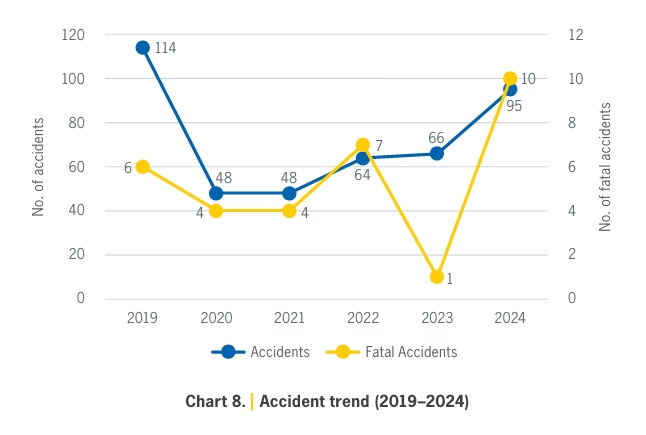
Image Credit of the International Civil Aviation Organization (ICAO) 2025 State of Global Aviation Safety Report.
2025 and 2024 also saw a shard decline in the amount of available staff, and total oversight in both aircraft maintenance and control regulations. This follows a similar pattern as other sectors, like oil manufacturing, which saw the shuttering of the Chemical Safety Board (CSB) in 2025.
Why This Matters to Houstonians
While the collision occurred near Washington, D.C., its implications extend well beyond the region. Houston is home to some of the busiest and most complex airspace in the country, including George Bush Intercontinental Airport, Hobby Airport, Ellington Field, and extensive military, medical, and industrial helicopter traffic tied to the Ship Channel, offshore energy operations, and emergency services.
Like the D.C. airspace, Houston regularly sees:
- Civilian and military aircraft operating in close proximity
- High-density helicopter traffic near commercial flight paths
- Complex air traffic control demands during peak travel periods
- Night operations and reduced-visibility conditions
The NTSB’s findings underscore a broader national issue: when airspace design, staffing, technology use, and regulatory oversight fail to keep pace with traffic volume, the margin for error narrows dramatically. The systemic breakdowns identified in this crash are not unique to one airport or one city.
For passengers, flight crews, and families, this tragedy is a reminder that aviation safety depends not only on pilots, but on coordinated systems, enforced technology standards, and proactive regulatory action.
Hire a Wrongful Death Lawyer in Houston
Accountability matters – not only for the families directly affected, but for public safety as a whole. Tragedies like the January 29, 2025 collision serve as stark reminders that preventable failures must be addressed before more lives are lost.
If you have lost a loved one due to an aviation accident or another catastrophic incident involving 18-wheelers, refinery explosions or any other type of incident involving wrongful death, you need to speak with a Houston wrongful death lawyer today. The Law Offices of Hilda Sibrian have worked tirelessly over the decades to ensure that our clients receive the support they need after accidents that result in the death of their family members.
Attorney Hilda Sibrian serves the Houston metropolitan area, including Sugar Land, Missouri City, La Porte, Beaumont, Pasadena, The Woodlands, The Heights, Bellaire, Kingwood, Baytown and of course Houston proper. Call our office today or fill out our online contact form for a free consultation.