

Quick Answer
If you were hurt in a METRORail crash, who pays depends on who caused it. When a driver turns or runs a light in front of the train, the claim is usually against that driver and their insurer, as in any crash. When METRO itself was at fault, the claim falls under the Texas Tort Claims Act, because METRO is a government body. That means a written notice within six months, a cap of $100,000 per person and other strict rules. Claims involving the City of Houston, such as a fire truck, require verified notice within 90 days.
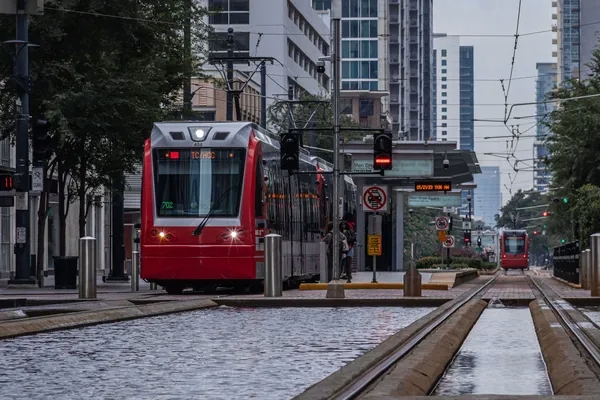
METRORail trains run right down the middle of some of Houston’s busiest streets. In downtown, Midtown, the Museum District and the East End, the Red, Green and Purple lines share intersections with cars, buses, bikes and people on foot. Most of the time that works. When it doesn’t, a light-rail train weighing many tons meets a car or a pedestrian who never had a chance.
This guide looks at recent METRORail crashes, who can be responsible, and the special deadlines that apply when the train operator or the city is involved. For a broader look at railroad crossings and freight trains, see our guide to train accident claims.
Recent METRORail crashes
Two crashes this year show the most common situations:
- San Jacinto and Wichita, Museum District (February). A northbound Red Line train collided with a truck shortly before noon. METRO officials said the vehicle allegedly made a right turn in front of the train. One passenger on the train reported an injury and was taken to a hospital for evaluation.
- Hogan Street and North Main, north of downtown (July 3). A Houston Fire Department engine responding to a call with its lights and siren on struck a METRORail train, and the collision derailed the train, officials said. One passenger was taken to a hospital with injuries described as non-life-threatening, and no firefighters were hurt. Reports gave slightly different times, around 6:45 to 6:50 p.m. Houston police led the investigation.
No cause has been announced in either crash beyond what officials said at the scene.
Why METRORail crashes happen
Unlike a freight railroad, METRORail runs mostly at street level, in lanes next to traffic. Crashes tend to happen when:
- a driver turns left or right across the tracks in front of a train, as officials said happened in February;
- a driver runs a red light or ignores the train signals at an intersection;
- a pedestrian or cyclist crosses the tracks near a station or mid-block;
- an emergency vehicle goes through an intersection on a call; or
- a train operator is distracted, misses a signal or brakes late.
Trains can’t swerve, and they need far more distance to stop than a car. Even at city speeds, people inside the train can be thrown into poles and seats, and people in a car or on foot can be badly hurt. If you were walking, read more about pedestrian accident claims in Houston.
Who may be responsible?
| Party | When they may be responsible | How the claim works |
|---|---|---|
| A private driver | Turned in front of the train, ran a light or ignored rail signals | A normal insurance claim or lawsuit; two years to sue |
| METRO | The train operator was negligent, or METRO property or equipment played a part | Texas Tort Claims Act: notice within six months, damage caps |
| The City of Houston | A city vehicle, such as a fire truck or police car, was involved | Tort Claims Act plus the city charter: verified notice within 90 days |
More than one party can share responsibility. Texas uses comparative fault, so each party’s percentage affects what an injured person recovers, and a person more than 50% at fault recovers nothing.
If you were a passenger on the train and a driver caused the crash, your claim is generally against that driver’s insurance. If the driver had little or no insurance, your own uninsured/underinsured motorist coverage may help, depending on your policy.
Claims against METRO: the Texas Tort Claims Act
METRO is the Metropolitan Transit Authority of Harris County. State law makes a transit authority like METRO a governmental unit under the Texas Tort Claims Act. That changes the rules in several ways:


- Limited types of claims. The Act allows claims for injuries caused by a government employee’s operation or use of a motor-driven vehicle or equipment, or by a condition or use of tangible property, when a private person would be liable.
- Damage caps. For a local government unit, the Act limits damages to $100,000 per person and $300,000 per incident for bodily injury or death. For a city, such as Houston, the limits are $250,000 and $500,000.
- Who you sue. Suing the government body generally rules out suing the individual employee over the same events, so the choice has to be made carefully.
- Emergency calls. When a city vehicle is responding to an emergency, as the fire engine was in July, the Act generally does not apply if the driver followed the laws for emergency vehicles or, where there are none, didn’t act with conscious indifference or reckless disregard for others’ safety.
The caps don’t limit a claim against a private driver who shares the blame. Our post on police chase crashes in Houston explains more about claims involving government vehicles.
Deadlines you can’t miss
- METRO: the Tort Claims Act requires notice within six months of the incident, describing the injury, the time and place, and what happened. The written notice may not be required if the government body already had actual notice of the injury, but it is not safe to count on that.
- City of Houston: the city charter requires written, verified notice to the mayor and city council within 90 days, with specific details about the injury and the claim.
- Private drivers: generally two years to file a lawsuit.
Because the government deadlines are so much shorter, talk to a lawyer early, even if you are still being treated.
What to do after a METRORail crash
- Get medical care and tell the doctor how you were hurt: thrown inside the train, hit by the train, or in a car that collided with it.
- Get the report number from the agency that responded, such as METRO Police or the Houston Police Department.
- Write down the details: the line, direction, nearest station or intersection, time, and train car number if you can see it.
- Take photos of the scene, traffic signals, your injuries and any vehicle damage.
- Get witnesses’ names and numbers, including other passengers.
- Keep your fare card or receipt and any messages from METRO.
- Don’t sign anything or give recorded statements to an insurer or claims office without advice.
Frequently asked questions
Can I sue METRO if I was hurt on the train?
Possibly. If the operator or METRO equipment caused the crash, a claim can be brought under the Texas Tort Claims Act, with its notice requirement and caps. If a driver caused it, the claim is usually against that driver.
How much can I recover from METRO?
Under the Tort Claims Act, a claim against a local government unit like METRO is capped at $100,000 per person and $300,000 per incident for bodily injury or death. A claim against another responsible party, such as a private driver, isn’t subject to those caps.
What if a METRORail train hit me while I was walking?
Investigators will look at the signals, where you crossed and what the operator did. Responsibility can be shared. Because the notice deadline for METRO is short, a lawyer should review the facts quickly.
What if a fire truck or police car hit the train?
The city may be responsible, but special rules apply to emergency vehicles on a call, and the City of Houston requires verified notice within 90 days.
Help after a METRORail accident in Houston
A light-rail crash can leave you hurt and facing government deadlines that are much shorter than usual. The Law Offices of Hilda Sibrian can review what happened, explain your options and help identify evidence that should be preserved.
Attorney Hilda Sibrian has served the Houston metropolitan area for over 22 years. Our Houston car accident lawyers help injured people in Houston, Sugar Land, Missouri City, La Porte, Pasadena, The Woodlands, The Heights, Bellaire, Kingwood, Baytown and Beaumont. We help drivers, passengers, pedestrians and families understand their options after serious collisions.
Call us today or use our online contact form for a free consultation.


