
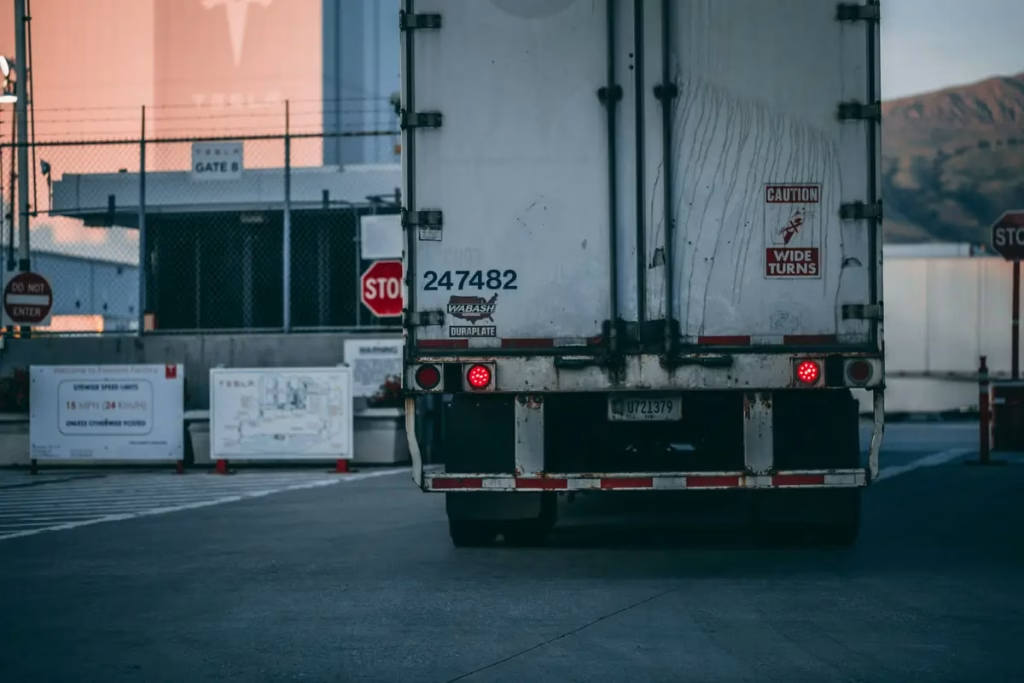
 Two of the most catastrophic types are underride and override collisions. Both involve a mismatch in height and mass between a passenger vehicle and a commercial truck or trailer, and both can bypass the passenger vehicle’s crash-protection systems in ways that lead to severe head, neck, and traumatic brain injuries – or death.
Underride crash
An underride crash happens when a smaller vehicle slides under the rear or side of a truck or trailer, allowing the truck structure to intrude into the passenger compartment. The intrusion often occurs above the car’s bumpers and crumple zones, which is one reason these crashes are disproportionately fatal.
Override crash
An override crash involves the opposite geometry: a large truck rides over a smaller vehicle, often in a rear-end impact where the truck climbs onto the passenger vehicle. In practice, “override” is often used to describe truck-on-car rear-end crashes where the smaller vehicle gets crushed under the front of the truck.
Why underride crashes are uniquely dangerous
In standard car-to-car collisions, occupant protection relies on the vehicle’s front-end structure and restraint systems. Car panels are designed to buckle and fold under pressure to reduce the overall force of impact. However, in underride scenarios, the passenger compartment can be compromised early because the striking car can slide under the truck chassis, bypassing these “self-protection countermeasures.” These cases often result in direct injuries to the driver and passenger, usually targeting the head, chest or neck. Underride crashes account for around 400-600 deaths per year, per the Insurance Institute for Highway Safety (IIHS).
This is why underride prevention has become a major focus of safety organizations and regulators, including the IIHS, which runs rear underride crash tests and recognizes stronger guard designs through its TOUGHGUARD program. Guards are the panels that hang from the semi-truck’s load. Underride crashes typically fall into one of three cases:
- Full width crashes
- 70% crashes
- 30% crashes
Common underride and override scenarios
Rear underride (car into trailer)
- Passenger vehicle strikes the rear of a stopped or slow trailer. These crashes can happen because of poor visibility, brake checking, or an accident in front of the trailer.
- Underride severity increases when the rear impact guard is weak, damaged, improperly mounted, or incompatible with offset impacts.
Side underride (car into side of trailer)
- Passenger vehicle impacts the side of a trailer (e.g., a trailer crossing an intersection, turning, or blocking lanes).
- Side underride guards are not uniformly required at the federal level the way rear guards are, which is one reason side underride remains a persistent safety concern.
Override (truck into car)
- A tractor-trailer rear-ends traffic and rides up over a passenger vehicle, often in congestion, construction zones, or sudden slowdowns.
- These cases often overlap with driver fatigue, anger, speed, distraction, and braking/maintenance issues.
The Most Important Trailer Safety Equipment: Rear Impact Guards (FMVSS 223/224)
Federal standards address rear underride protection for many trailers and semitrailers through:
According to federal regulations, “The purpose of this standard is to reduce the number of deaths and serious injuries that occur when light duty vehicles collide with the rear end of trailers and semitrailers.” These regulations heavily impact underride crash cases.
The NHTSA has also recently issued a final rule upgrading rear impact guard requirements – strength and energy absorption – aimed at better protection in multiple crash scenarios, and framed the rule as part of implementing underride provisions from the Bipartisan Infrastructure Law/IIJA.

Who may be liable in an underride/override case (Texas)
Underride/override cases often have multiple defendants because the crash mechanics point to both operations and equipment:
- Driver negligence – Speed, following distance, fatigue, distraction, impairment, lane changes, unsafe merging.
- Motor carrier (trucking company) – Vicarious liability for the driver in scope of employment, or direct negligence including hiring, training, supervision, safety policies, dispatch pressure, maintenance programs.
- Trailer owner / maintenance provider – Rear guard damage, corrosion, missing components, improper repairs.
- Manufacturer / product liability – Defective guard design, inadequate mounting, foreseeable failure in offset conditions, or failure-to-warn (case-specific).
- Shippers / loaders / brokers (sometimes) – Unsafe loading affecting braking/handling, dispatch decisions, and control issues can broaden the defendant set depending on facts and contracts.
How these crashes show up in Houston and across Texas
Texas highways and freight corridors (I-10, I-45, I-69/US-59, Beltway 8, SH-288, and port/industrial routes) increases exposure to:
- nighttime trailer traffic,
- congestion-driven rear-end impacts (override risk),
- wide-turn and intersection conflicts (side underride risk),
- work zones and shoulder events.
Frequently asked questions
Is an underride guard required on every trailer?
Federal rear guard rules apply to most trailers/semitrailers, but there are exceptions and details by trailer type and use. The baseline federal framework is FMVSS 223/224.
If the car hit the truck, can the truck still be at fault?
Yes. Fault can involve trailer conspicuity/visibility, illegal stops, unsafe lane blocking, inadequate guarding, poor maintenance, or operational negligence – depending on facts.
Are side underride guards required nationwide?
Not uniformly under federal law in the same way rear guards are; this is an active safety-policy topic and varies by equipment type and jurisdiction.
Hire a Houston Trailer Crash Injury Attorney
Underride and override truck crashes are catastrophic because they defeat normal crash-protection geometry. If you have been injured in a commercial vehicle or 18-wheeler truck accident, you need to contact an experienced Houston personal injury attorney today.
The Law Offices of Hilda Sibrian have served the Houston community for over 20 years. Hilda Sibrian serves the Houston metropolitan area, including Sugar Land, Missouri City, La Porte, Beaumont, Pasadena, The Woodlands, The Heights, Bellaire, Kingwood, Baytown and of course Houston proper. Call our office today or fill out our online contact form for a free consultation.